A CDN (content delivery network) is a network of servers in many locations that caches and serves websites, images, video and software updates close to users. Instead of every request travelling to the origin server, visitors get content from a nearby edge server, which is faster and takes load off the origin.
How it works
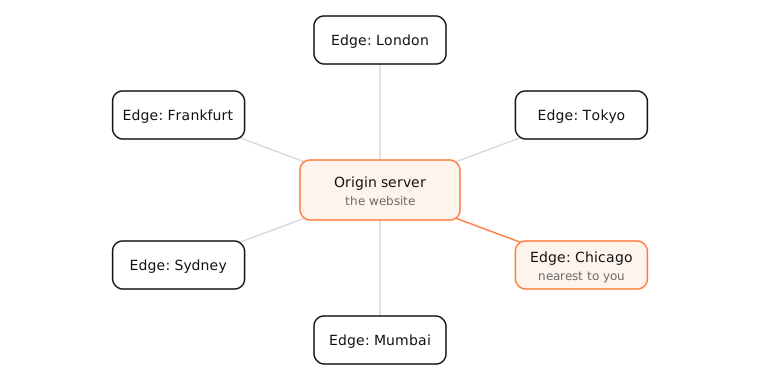
How a request reaches the edge
The site points its domain at the CDN (often a CNAME like example.com.cdn.cloudflare.net). DNS or anycast routing sends you to a nearby edge server. If that edge has a fresh copy, it answers immediately; if not, it fetches it from the origin, returns it, and caches it for the next visitor.
What CDNs do besides caching
- Terminate TLS close to users, saving round trips.
- Absorb DDoS attacks and filter bots (web application firewalls).
- Optimise images, compress and run code at the edge.
Big providers
Cloudflare, Akamai, Amazon CloudFront, Fastly, Google Cloud CDN, Microsoft Azure Front Door, and private CDNs run by Apple, Netflix and others. Apple's software updates and the App Store come from Apple's own CDN.
Why it matters when you monitor connections
Many unrelated sites share the same CDN addresses, so an IP alone often tells you “Cloudflare” or “Akamai” rather than the actual site. The domain name the app looked up is the better clue.
Examples
$ dig +short www.apple.com
www-apple-com.v.aaplimg.com.
www.apple.com.edgekey.net.
e6858.dsce9.akamaiedge.net.
…
The CNAME chain shows apple.com handing visitors to a CDN; the exact chain depends on where you are.
On a Mac
dig +short <domain> reveals CNAMEs to CDN names like cloudfront.net, akamaiedge.net or fastly.net. curl -sI https://example.com often shows CDN headers such as cf-ray, x-amz-cf-pop or x-served-by.
See it in the app
LightAtom's connections view shows the domain name behind each shared CDN address; the Map may place those addresses where the CDN is registered rather than at the nearby edge.
Frequently asked questions
What does a CDN do?
It caches and serves content from servers close to users, making sites faster and protecting the origin server from load and attacks.
Is Cloudflare a CDN?
Yes, along with DNS, security and other services. Akamai, CloudFront and Fastly are other major CDNs.
Why does my Mac connect to Akamai or CloudFront?
Apps and websites deliver files, updates and media through these CDNs. The connection is to the app's content, served by the CDN.
Does a CDN make every site faster?
Mostly for static content and distant visitors. Dynamic, personalised pages still need the origin, though CDNs speed up the connection to it.