Bandwidth is the maximum amount of data a network connection can carry per second, usually measured in megabits per second (Mbps). Think of it as the width of a pipe: more bandwidth lets more data flow at once, but doesn't make each trip faster.
How it works
Bits, not bytes
Connections are rated in bits per second (Mbps, Gbps); file sizes and download progress are in bytes (MB, GB). There are 8 bits in a byte, so a 100 Mbps connection downloads at most about 12.5 MB per second.
Bandwidth, throughput and latency
- Bandwidth: the capacity of the link, what your plan promises.
- Throughput: what you actually get, after overhead, Wi-Fi limits, congestion and the server's own speed.
- Latency: how long each round trip takes. A connection can have high bandwidth and high latency (satellite), or low bandwidth and low latency.
Upload and download
Most home connections are asymmetric: cable might be 500 Mbps down and 20 Mbps up. Upload matters for video calls, cloud backups and sending large files. Fiber is often symmetric.
Sharing
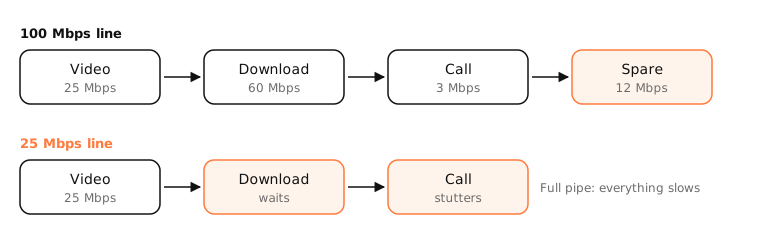
Bandwidth is shared by every device and app on your network. One cloud backup can use all of a small upload link, making calls stutter for everyone, which is also how bufferbloat shows up.
Examples
Rough needs per activity:
| Activity | Bandwidth |
|---|---|
| Video call (HD) | 2–4 Mbps each way |
| Streaming HD video | 5–8 Mbps |
| Streaming 4K video | 15–25 Mbps |
| Online gaming | 3–5 Mbps (latency matters more) |
| Downloading a 5 GB game at 100 Mbps | about 7 minutes |
On a Mac
networkQualitymeasures your current download and upload capacity.- Activity Monitor's Network tab shows how much data each process has sent and received.
nettop -Pshows live rates per process, useful to find what's using your bandwidth.
See it in the app
LightAtom's connections view shows each app's live download and upload rate, so you can see exactly where your bandwidth goes.
Frequently asked questions
What is the difference between bandwidth and speed?
Bandwidth is capacity: how much data the connection can carry per second. Speed usually means the throughput you actually get, which is lower, plus how responsive it feels, which depends on latency.
How much bandwidth do I need?
For one person streaming HD and making calls, 25 Mbps is enough. A household streaming 4K on several screens while working from home is comfortable with 200 Mbps or more.
Why is my download slower than my plan?
Wi-Fi limits, other devices using the connection, the server's own speed, and protocol overhead. Test over Ethernet with networkQuality to see your line's real capacity.
What is the difference between Mbps and MB/s?
Mbps is megabits per second; MB/s is megabytes per second. Divide Mbps by 8 to get MB/s: 100 Mbps ≈ 12.5 MB/s.